
Chronic Heart Failure and Social Security Disability: A Guide to Getting Benefits
Living with Chronic Heart Failure (CHF) is a life-changing event. CHF is a serious condition where your heart can’t pump enough blood to the rest of your body. This can lead to serious health problems and symptoms like extreme fatigue, shortness of breath, and swelling. For many people, these symptoms make it impossible to work and keep a steady job.
If you are struggling with this condition and can no longer work, you may be able to get financial help from the Social Security Administration (SSA). This help comes from two programs: Social Security Disability Insurance (SSDI) and Supplemental Security Income (SSI).
This guide will explain how to qualify for Social Security Disability with a Chronic Heart Failure diagnosis.
The Steps to Getting Social Security Disability for Chronic Heart Failure
The SSA uses a 5-step process to decide if you are disabled. For CHF claims, the most important part is often Step 3, where the SSA checks if your condition meets a specific listing in the “Blue Book.”
How the SSA Reviews Your Claim
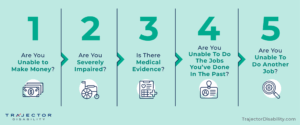
The SSA uses a careful 5-step process to decide if you are disabled.
- Are you working at a Substantial Gainful Activity (SGA) level? If your monthly earnings exceed the SGA limit, you are generally considered not disabled, regardless of your medical condition.
- Is your condition severe? Your health problem must be serious enough to greatly limit your ability to do basic work activities, like walking, standing, or lifting.
- Does your condition meet or medically equal a listing in the Blue Book? The SSA maintains a “Listing of Impairments” (often called the “Blue Book”) that describes conditions severe enough to prevent work. Peripheral Artery Disease has its own listing.
- Can you do your past job? If your condition doesn’t meet a listing, the SSA will decide if your health problems keep you from doing any of your old jobs from the last 5 years.
- Can you do any other kind of work? If you can’t do your old job, the SSA will look at your age, education, work experience, and Residual Functional Capacity (RFC) to decide if you can switch to a new type of job.
For Chronic Heart Failure claims, the process often focuses heavily on Step 3. If your condition meets the specific rules, your claim can be approved right away.
SSA Blue Book Listings for Chronic Heart Failure (Section 4.02)
The SSA’s “Blue Book” (Listing of Impairments) provides the medical rules you must meet to automatically qualify for disability benefits. Section 4.02, “Chronic heart failure,“ is the key listing for CHF.
To meet this listing, you must have medical proof that your heart failure is severe. You need to show one of two specific scenarios, even with a doctor’s care.
- Scenario A: Signs of Heart Failure with a Medical Test: You must have signs of heart failure (like shortness of breath, fatigue, or chest pain) that seriously limit your daily life. On top of this, you need a medical test showing a serious problem, such as:
- An ejection fraction (EF) of 30% or less. This number shows how much blood your heart pumps out with each beat. A normal EF is much higher.
- An enlarged heart (left ventricle) that is bigger than a certain size.
- Scenario B: Repeated Severe Episodes: You must have had three or more serious episodes of acute heart failure within a 12-month period. These episodes must have caused a lot of fluid in your body and required you to stay in the hospital or get emergency care for at least 12 hours.
It’s very important to note that you must be receiving ongoing treatment for your CHF. The SSA wants to see that you are following your doctor’s advice and that your condition is still severe despite that treatment.

Building a Case Based on Your Limits (Residual Functional Capacity)
If your Chronic Heart Failure does not meet the specific “Blue Book” listing, you can still get benefits. This is done by proving that your symptoms and limits prevent you from working. This is where the Residual Functional Capacity (RFC) assessment is crucial. An RFC shows the SSA what you can still do despite your health problems.
You must document all of your symptoms and how they impact your ability to do a job. This includes:
- Extreme Fatigue: This is a key symptom of CHF. You need to show how it limits your ability to stay focused or work a full 8-hour day.
- Shortness of Breath: Document how this affects your ability to walk, stand, or even sit for a long time. You can’t do a job if you can’t even get to the desk or stand in one spot.
- Dizziness or Chest Pain: These symptoms can be very dangerous and make it impossible to work safely.
- Swelling (Edema): Swelling in your legs or feet can make it very hard to stand or walk.
The Most Important Medical Evidence You Need
To successfully prove your claim, you must provide the SSA with objective medical evidence. This includes:
- Results from tests like an echocardiogram, exercise stress test, or cardiac catheterization. These tests give hard numbers and proof of your heart’s condition.
- Detailed treatment records from your heart doctor (cardiologist). These records must show all of your symptoms, the treatments you have received, and how you have responded to them.
- Hospital and emergency room records. These are proof of any serious episodes you have had.
- A detailed statement from your doctor. Your doctor’s opinion is very important. The best statements are on a formal RFC form and explain exactly how your CHF limits your ability to work.
Don’t hesitate to contact us to speak with our team of experts.
Trajector Disability offers comprehensive support throughout the disability claim process. Our team of experts can help you determine your eligibility, gather all necessary evidence, prepare and submit your application, and guide you through the appeals process if your claim is denied.
Schedule a free consultation, and rest assured: you won’t be charged unless your claim is approved.
FAQs
Does having Chronic Heart Failure automatically qualify me for disability?
No. A diagnosis of CHF alone is not enough. You must prove that your condition is severe enough to meet the rules in the "Blue Book" or that it keeps you from working for at least 12 months. The SSA will look closely at your medical records to see the true severity of your heart failure.
What is an "ejection fraction" and why is it important for my claim?
Ejection fraction (EF) is a number that shows how much blood your heart's main chamber pumps out with each beat. A normal EF is between 55% and 70%. The SSA's "Blue Book" listing for CHF specifically mentions an EF of 30% or less as a key sign of a disabling condition. This test is a critical piece of objective evidence for your claim.
How do I prove my symptoms are "persistent" and "severe" enough to qualify?
The best way to prove this is with a long history of medical records. The SSA wants to see that your symptoms have continued for many months, even with regular treatment. They will also look for hospital records or notes from your doctor that show your condition is so bad it seriously limits your daily life.
If I have other health problems in addition to Chronic Heart Failure, does that help my case?
Yes. The SSA will consider the combined effect of all of your health problems, not just your CHF. For example, if you also have diabetes, high blood pressure, or kidney issues, the combined symptoms and limitations may make your case much stronger.