
Complete Your SSA-3368 Adult Disability Report (Step-by-Step)
Navigating the Social Security Disability (SSD) application process requires careful attention to detail. The Adult Disability Report (Form SSA-3368-BK) and the Work History Report (Form SSA-3369-BK) are two of the most critical documents you’ll submit. They give the Social Security Administration (SSA) and the Disability Determination Services (DDS) the facts they need to decide if you qualify for benefits.
Completing the SSA-3368 and SSA-3369 forms correctly can make or break your disability claim. This guide explains how to fill out each section step-by-step, what information to include, and common mistakes that lead to delays or denials.
Why the SSA-3368 and SSA-3369 Are Critical
These reports serve as the vocational (work) evidence for your claim, directly answering the question: Can you still perform your Past Relevant Work (PRW)? Errors, omissions, or vague language are a leading cause of denial. If your reported past job duties conflict with your claimed limitations (even slightly) the DDS may determine you can still perform your past work, which ends your claim at Step 4 of the evaluation process.
The reports provide the DDS with:
- Detailed information on all medical problems that limit your ability to work.
- The addresses and phone numbers needed to collect your medical records (the evidence trail).
- A precise breakdown of the physical and mental demands of your past jobs.
- A functional explanation of how your current limitations (e.g., pain, fatigue, concentration issues) make it impossible to meet those demands.
Preparation: Items You Need to Gather
Before you start filling out the forms, take the time to gather all necessary information. This will save you time and prevent critical mistakes.
| Document You Need | Details to Collect |
| Medical Records | Names, addresses, and phone numbers for all doctors, clinics, therapists, and hospitals for the last 12 months. |
| Medications | A complete list of all prescription and over-the-counter medicines, including dosage and the prescribing doctor. |
| Work History | A list of all jobs held in the 5 years immediately before your disability began, including employer contact information and dates worked (month and year). |
| Test Results | Dates and locations for major medical tests like MRIs, X-rays, blood tests, or psychological evaluations. |
The 5-Year Rule: The SSA officially changed the rule to consider only the work you performed during the 5 years immediately before your disability began to determine Past Relevant Work (PRW). This rule change, effective June 2024, simplifies the process and reduces the chance that an older, more demanding job will be used to deny your claim.
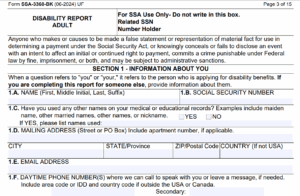
Completing the SSA-3368-BK (Adult Disability Report)
The SSA-3368 is the main document that covers your health, contacts, and basic work history.
Sections 1 & 2: Background and Contacts
- Your Information: Fill in your personal details and Social Security number.
- Third-Party Contact: Provide the name and number of a friend or family member who knows about your medical problems and how they affect your daily life. The SSA may contact this person to get a clearer picture of your day-to-day struggles.
Section 3: Medical Conditions
- List Everything: Include all physical and mental issues (such as anxiety, depression, chronic headaches, etc.) that limit your ability to work. You must include conditions you might not consider disabling on their own, as the SSA considers the total effect of all your health problems.
- Use Simple Terms: If you don’t know the exact medical name, it’s fine to use your own words (e.g., “very bad back pain”).
Section 4: Work Activity (Establishing the Onset Date)
- The Big Question: This section asks for your disability onset date; the exact day you believe you became unable to work because of your health.
- Be Strategic: The date you choose affects when you can start receiving benefits and the amount of back pay. A strong date is usually linked to a major event, such as when your doctor told you to stop working, a major surgery, or the last day you physically worked a full shift.
- Note Changes: Explain if your condition forced you to cut back hours, change duties, or miss work days before you stopped working entirely.
Sections 7 & 8: Medical Treatment (The Evidence Trail)
These sections are vital because they allow the DDS to collect the medical records needed to support your claim.
- Section 7 (Medicines): List every medication, the strength/dosage, and who prescribed it.
- Section 8 (Treatments): Be sure to include the full name, address, phone number, and the dates of your first and last visits for every medical source. If the SSA can’t find your records, your claim will be delayed or denied.
Section 11: Remarks (Focus on Function)
Do not leave this section blank. Use it to give specific examples of your limitations that you couldn’t fit elsewhere.
- Focus on ADLs: Describe how your condition affects your Activities of Daily Living (ADLs):
- “Because of severe fatigue, I must lie down and rest for 3 hours every afternoon, making it impossible to hold a full-time schedule.”
- “My joint pain is too severe to stand for more than 10 minutes at a time, or to lift anything heavier than a gallon of milk.”

Completing the SSA-3369-BK (Work History Report)
The SSA-3369 is often requested as a separate form, especially if you had multiple jobs. Its goal is to create a detailed work profile for the DDS examiner to compare against your current physical capacity, known as your Residual Functional Capacity (RFC).
How to Detail Each Job
When describing your job, always paint a clear, honest picture of the job at its highest demands before your condition limited you.
- Job Title and Type of Business: Don’t just write “Laborer” or “Manager.” Write the title and the type of business (e.g., “Laborer at a Construction Site” or “Retail Manager at a Grocery Store”).
- Job Duties and Tools: Go beyond the title. Instead of “Managed Inventory,” write: “Used a handheld scanner for 6 hours a day; operated a manual pallet jack to move boxes; and lifted up to 40-pound cartons to stock shelves.”
- Physical and Mental Requirements:
- Pounds Lifted/Carried: State the maximum weight you lifted, even if you only did it occasionally. If your job required lifting 50 pounds, you must list that number.
- Hours Spent Standing, Sitting, and Walking: Be precise. In the section that asks for this breakdown, ensure the hours add up to your total shift time. For example, in an 8-hour shift, you cannot list 6 hours standing and 6 hours sitting.
- Mental Demands: Detail requirements for sustained focus, ability to handle the public, work pace, and supervision of others.
Key Mistakes That Lead to Denial
- Vague Language: Never say, “I did general office work” or “I was on my feet a lot.” Use specific figures: “Lifted 15-pound boxes frequently (up to 3 hours per day),” “Sat for 4 hours, stood/walked for 4 hours.”
- Inconsistencies: Your job duties listed on the SSA-3369 must be consistent with your medical records and your limitations described on the Function Report (SSA-3373). For instance, if the SSA-3369 shows your job required sitting 8 hours, but your medical records confirm you can only sit for 30 minutes, this shows a clear inability to perform the job.
- Exaggerating Duties: Be honest. If your former employer states you only lifted 10 lbs, but you wrote 50 lbs, your credibility will be harmed. The DDS relies on resources like the government’s Dictionary of Occupational Titles (DOT) and the new Occupational Information System (OIS) data to classify jobs accurately.
New Development: The Occupational Information System (OIS)
The SSA is actively transitioning its job classification data from the decades-old Dictionary of Occupational Titles (DOT) to the new Occupational Information System (OIS).
- Strategic Importance: The OIS uses more current labor market data and potentially more detailed descriptions of job demands. Your SSA-3369 should be written to provide sufficient detail for a DDS examiner to accurately classify your work under these new, modern standards. Vague language like “general office duties” will likely be rejected in favor of specific tasks.
The Importance of an Experienced Social Security Disability Advocate
Whether you’re just beginning the process applying for disability benefits or have been denied and are fighting for your benefits, we can help.
Trajector Disability offers comprehensive support throughout the disability claim process. Our team of experts can help you determine your eligibility, gather all necessary evidence, prepare and submit your application, and guide you through the appeals process if your claim is denied.
FAQs
What is the deadline for submitting the SSA Work History Report (SSA-3368)?
The SSA will send you a letter requesting the form and will provide a deadline, usually around 10 days to 3 weeks. It is crucial to meet this deadline, or your claim could be denied for lack of cooperation. If you need more time, you should contact the DDS examiner immediately to request an extension.
What if I can't remember the exact details of a job from five years ago?
If you cannot remember exact details (like the weight you lifted or the phone number of the employer), write "Don't Know" rather than guessing. Guessing can lead to inaccuracies that contradict your medical evidence.
How does the SSA-3368 differ from the Function Report (SSA-3373)?
The SSA-3368 (Work History Report) describes the requirements of your old job as they existed before you became disabled. The SSA-3373 (Function Report) describes your current limitations and how your disability affects your daily life.